


October 2026 EnergyWise Tip: Forklifts
October 2026 EnergyWiseSM Tip: Forklifts
By: Energy Efficiency Program Manager Cory Fuehrer
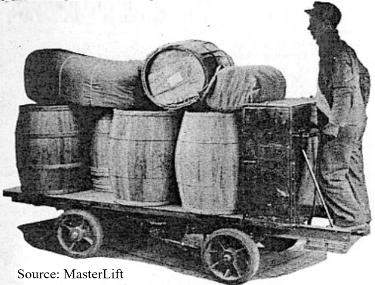
In 1906, the Pennsylvania Railroad began using the first battery-powered industrial truck to move
baggage between platforms, speeding the loading and unloading of passenger trains. Often nicknamed
the "Electric Porter," this equipment became the original predecessor of today’s electric
forklifts.
While the need for more lifting power led to the development of fuel-powered forklifts during
World War I, recent developments and cost reductions in lithium-ion battery technology have led to
electric lifts outselling fuel-powered by nearly 3 to 1 in the world market today. Distribution
centers, manufacturing facilities and third-party logistics providers are heavily investing in
electric forklifts and intelligent fleet management systems to improve productivity and reduce
operational downtime. Here are a few more advantages electric forklifts have over fuel-powered
lifts:
Less maintenance – Upkeep is generally limited to brakes, tires, and basic battery care.
Fewer moving parts – Unlike fuel-powered units, electric forklifts have no engine, transmission or
radiator.
No emissions – In addition to eliminating ventilation concerns, electric lifts are safer for food
and pharmaceutical facilities.
Lower cost – In addition to reducing battery cost and bringing initial purchase prices down to
comparably sized fuel-powered forklifts, electric units boast lower maintenance and energy costs.
Smoother, quieter ride – Without an internal combustion engine producing noise and vibration,
electric forklifts provide a better user experience.
Smoother acceleration – Since electric units do not have a clutch, operators do not experience
the common “jump” of an open differential used in fuel-powered forklifts.
Often lighter, smaller – Unless the weight is necessary for counterbalancing, owners can often
select an electric lift that weighs less and has a smaller footprint than a fuel-powered unit. This
makes it easier to maneuver in tight aisles, easier to transport and less likely to damage floors.
Repowering – Batteries can be easily swapped in the same amount of time or less than refueling.
Recharging batteries during off-peak hours allows large facilities to take advantage of certain
utility rate programs.
In partnership with Nebraska Public Power District, your local public power provider wants to help
you do the heavy lifting. To find additional ways electrical technologies can make it easier
to complete the job, contact your local utility or visit www.energywisenebraska.com.
